"An Attorney near me" - Cape Town legal concierge
lawyer@capetownlawyer.co.za or WhatsApp
Sectional Title Conveyancing & Scheme Governance in South Africa
It is critical that you check that your conveyancer is a member of the Legal Practice Council and verifies all body corporate resolutions before lodging transfer.
Transferring a sectional title unit in South Africa involves strict statutory formalities under the Sectional Titles Act 95 of 1986 (STA) and the Sectional Titles Schemes Management Act 8 of 2011 (STSMA). From verifying Section 15B(3) levy clearance certificates to registering notarial cessions of exclusive use areas and checking trustee resolutions, cutting corners can render a property transfer void and expose both trustees and conveyancers to personal cost orders.
Sectional Title Pro-Rata & Special Levy Calculator
A. Registration Month Ordinary Levy Apportionment
B. Special Levy Apportionment
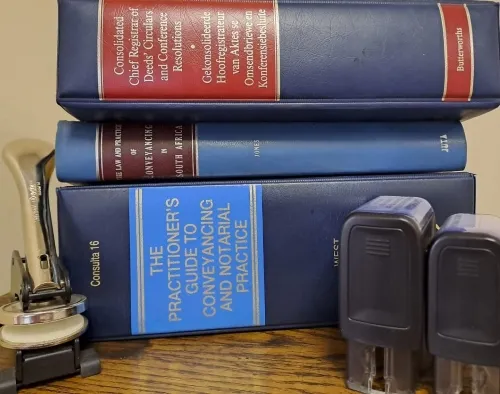
Essential Sectional Title Transfer Guides
- Exclusive Use Areas: Section 27 Notarial Cessions vs Rules
- How parking bays, gardens, and storerooms are created and transferred - comparing registered real rights requiring a Notary Public and Notarial Deed of Cession under Section 27 of the STA against rule-based allocations under Section 10(7) of the STSMA.
- Special Levies in Sectional Title Transfers (Section 3(3) STSMA)
- Who pays a special levy when a unit is sold, when trustees can validly raise a special contribution under Prescribed Management Rule 21(3)(a), and how Offer to Purchase clauses override the statutory pro-rata default.
- Levy Clearance Certificates (Section 15B(3))
- How Section 15B(3) certificates work, what a body corporate can legally demand prior to transfer, and how clearance figures and arrear levy disputes are resolved.
- Conveyancing Transfer Documents & Signing Rules
- Understanding the power of attorney to pass transfer, FICA affidavits, SARS TDC01 declarations, and the two-signature requirement for Bodies Corporate under Management Rule 10(1).
- The Property Transfer Process
- Step-by-step timeline of a South African property transfer, from signing the Offer to Purchase to Deeds Office lodgement and registration.
- Choosing & Vetting a Conveyancer
- Why independent conveyancing oversight protects buyers, sellers, and bodies corporate from defective transfers and costly litigation.
- Sectional Title Resolutions: Trustee, Ordinary, Special & Unanimous Thresholds
- Which Body Corporate decisions require a 50% ordinary vote, a 75% special resolution (in value and number), or an 80%-quorum unanimous resolution under the STSMA, plus the Management Rule 10(1) two-signature rule.

Case Note: Trustee Self-Dealing & Conveyancer Liability (Lee v C.H Body Corporate [2026] ZAGPJHC 1285)
Can a sitting sectional title trustee purchase immovable property directly from the body corporate through an informal agreement with the chairperson? And what happens to the conveyancer who registers that transfer using an inaccurate clearance certificate? In Lee and Another v C.H Body Corporate (A2023/24848) [2026] ZAGPJHC 1285, a Full Bench of the Johannesburg High Court delivered a stern warning to conflicted trustees and rubber-stamp conveyancers alike.
- Case Summary
- Citation: Lee and Another v C.H Body Corporate (A2023/24848) [2026] ZAGPJHC 1285
- Court: High Court of South Africa, Gauteng Local Division, Johannesburg (Full Bench)
- Judges: Maier-Frawley J (Van Aswegen AJ and Mphahlane AJ concurring)
- Date of Judgment: 11 November 2026
- Core Issues: Unauthorised alienation of body corporate property, breach of trustee fiduciary duties, defective execution of transfer documents, false Section 15B(3) certification, and restitutio in integrum.
Factual Background
During October 2015, the first appellant (Ms Lee) served as a trustee of the respondent body corporate in Johannesburg. While holding fiduciary office, she concluded a written deed of sale in her personal capacity to purchase a body corporate-owned flat (Section 9, Unit 108), together with exclusive use rights over two rooms and a parking bay forming part of the common property, for R1,000,000.00.
The property transfer process was attended to by the second appellant, a practising conveyancer, acting on a power of attorney signed by a single fellow trustee (Ms Beck). Transfer was registered in the Deeds Office on 15 December 2015.
Six years later, in October 2021, the scheme's managing agent circulated a notice for a Special General Meeting (SGM) scheduled for 1 December 2021, placing an item on the agenda for owners to retroactively "approve and ratify" the 2015 sale. When a member of the body corporate (Mr Cassim) requested the underlying transaction documents, both the managing agent and the conveyancer refused to disclose them. Mr Cassim successfully brought an urgent High Court application before Mia J, securing an interdict restraining the SGM from ratifying the void transaction and compelling the production of the sale records.
Four Fatal Flaws in the Sectional Title Transfer
Once the conveyancing file was compelled into the open, the court record exposed systemic non-compliance with the Sectional Titles Act 95 of 1986 (STA) and the prescribed Annexure 8 Management Rules in force in 2015:
- Breach of Trustee Fiduciary Duties (Section 40 of the STA)
- Under Section 40 of the STA, a trustee stands in a strict fiduciary relationship to the body corporate and must avoid any material conflict between personal interests and those of the scheme.
- Ms Lee contended that the former chairperson had verbally suggested and approved the sale. However, she failed to notify every other trustee of the nature and extent of her personal interest as required by Section 40(2)(b)(ii).
- She stood on both sides of the transaction and derived personal economic benefit by letting the unit out for rental income.
- Under Annexure 8 Management Rule 23, she was disqualified from voting on any contract with the body corporate in which she held an interest.
- No unanimous written approval from all members of the body corporate (cognisant of all material facts) was ever obtained under Section 40(4) to cure the fiduciary breach.
- Invalid Execution of Sale and Transfer Documents (Management Rule 27)
- Under Section 39(1) of the STA, trustees possess only the powers conferred by the Act and the rules; any decision or act beyond those powers is unlawful and invalid (Trustees for the time being of the Legacy Body Corporate v Bae Estates and Escapes (Pty) Ltd 2022 (1) SA 424 (SCA)).
- At the time of the transfer, Management Rule 27 (now carried forward even more strictly in Management Rule 10(1) under the 2016 STSMA Regulations) dictated that no document signed on behalf of the body corporate was valid and binding unless signed by two trustees, or by one trustee and the managing agent.
- In this matter, only a single trustee signed the sale agreement and the power of attorney to pass transfer, unsupported by any trustee or member resolution.
- Unlawful Transfer of Exclusive Use Areas (Section 27 of the STA)
- The transaction purported to transfer exclusive use rights to Parking Bay P81 and two common property rooms via an ordinary deed of transfer riding on the sale of the unit.
- In terms of Sections 27(4)(a) and 27(5) of the STA, exclusive use rights over common property can only be transferred via registration of a notarial deed of cession entered into by the parties, or cancelled via a notarial deed of cancellation authorised by a special resolution of members. Neither a special resolution nor a notarial deed existed.
- Dishonest Section 15B(3) Conveyancer Certification
- To effect registration in the Deeds Office, the conveyancer signed a statutory Section 15B(3) certificate, certifying that all monies due to the body corporate in respect of the section had been paid as at the date of registration.
- In truth, the full R1 million purchase price had not been paid by 15 December 2015 - the trustee paid off the outstanding balance in instalments over the subsequent 10 months.

The Appeal: Statutory Technicalities vs Substantive Law
In February 2026, the court a quo (Mfenyana J) ordered the re-transfer of the unit to the body corporate against repayment of R868,565.20, imposed punitive attorney-and-client costs against both appellants (de bonis propriis against the conveyancer), and referred the conveyancer to the Legal Practice Council (LPC) for investigation.
On appeal to the Full Bench, the appellants raised a technical defence: the court below had penalised them and ordered the LPC referral for violating the Sectional Titles Schemes Management Act 8 of 2011 (STSMA), whereas the STSMA only came into operation on 7 October 2016 - nearly a year after the 2015 transfer.
Maier-Frawley J dismissed this contention on settled appellate principles:
- Appeals target orders, not reasons
- Citing Tecmed Africa (Pty) Ltd v Minister of Health [2012] ZASCA 64, the Full Bench reiterated that an appeal lies against the substantive order of the lower court, not its reasoning.
- Because the 2015 transaction was thoroughly unlawful under the predecessor statute (the 1986 STA and Annexure 8 rules), the lower court's citation of the STSMA did not rescue the appellants.
- Conveyancer's duty of meticulous care
- Relying on Margalit v Standard Bank of South Africa Ltd 2013 (2) SA 466 (SCA), the court emphasised that a conveyancer's duty of care extends beyond their immediate mandator to all parties whose interests are affected by the transfer.
- Certifying to the Registrar of Deeds that the full purchase price was paid when it was not constituted dishonesty, fully justifying both the LPC referral and the personal punitive costs order (de bonis propriis).
Restitution and the Purchase Price Refund Adjustment
While the body corporate had initially attempted to reclaim the unit without refunding the purchase price (alleging unsubstantiated suspicions regarding the lawfulness of the trustee's funds), both parties ultimately accepted on the papers that restitutio in integrum required mutual restoration.
The Full Bench found that the lower court had misdirected itself on the facts by overlooking direct payments reflected in the annexures:
- R868,656.20 was paid to the body corporate via the conveyancer's trust account; and
- R132,000.00 was paid by the trustee directly to the body corporate (comprising R130,300.00 in capital and R1,700.00 in late-payment interest).
The Full Bench varied the refund amount to R1,000,656.20 and corrected a clerical error in the parking bay description (from Parking P66 to Parking P81) under Uniform Rule 42(1)(b). Because these minor adjustments occupied minimal court time while the appellants' primary grounds of appeal were indefensible, the Full Bench dismissed the balance of the appeal and ordered the trustee and the conveyancer to pay the body corporate's appeal costs jointly and severally on Scale C.
Frequently Asked Questions: Sectional Title Transfers
- How many trustees must sign a body corporate sale agreement or power of attorney?
- Under Management Rule 10(1) of the STSMA Regulations (and previously Management Rule 27 under Annexure 8 of the 1986 Act), no document signed on behalf of a body corporate is valid and binding unless it is supported by a trustee resolution and signed either by two trustees, or by one trustee and the managing agent.
- Can an exclusive use parking bay be transferred on an ordinary deed of transfer?
- If the exclusive use area (such as a parking bay, storeroom, or garden) is registered under Section 27 of the Sectional Titles Act, it cannot be transferred by way of an ordinary deed of transfer. It must be ceded via a notarial deed of cession prepared by a Notary Public and registered in the Deeds Office. Rule-based exclusive use areas allocated under Section 10(7) of the STSMA are governed by the scheme's management or conduct rules.
- What is a Section 15B(3) certificate in sectional title conveyancing?
- Before the Registrar of Deeds will register the transfer of a sectional title unit, the conveyancer must lodge a certificate under Section 15B(3) of the Sectional Titles Act confirming that the body corporate has certified that all monies due to it by the transferor in respect of the unit have been paid (or that provision has been made to the satisfaction of the body corporate for payment).
- Who pays conveyancing fees in a sectional title transfer?
- Usually the buyer of the sectional title unit pays the conveyancing fees and transfer costs, while the seller typically pays the body corporate's fee for issuing the levy clearance certificate and any arrear levies up to date of transfer.
Property transfer & sale Info
Sellers of property & buyers, speak to a property lawyer before you hire an estate agent!
- The property transfer process in South Africa - protect your interests.
- Conveyancing lawyers in Cape Town
- Transfer costs calculator for property anywhere in South Africa
- Can I negotiate transfer costs?
- Transfer attorney fees
- Fixed fee conveyancing in South Africa.
- Understanding the various conveyancing costs.
- Conveyancing quote
- New conveyancing fees from 27 May 2024
- Deeds office fees 29 Feb 2024.
- Law Society conveyancing fees 2023
- Law Society conveyancing fees 2024
- Conveyancing fees 2025
- Conveyancing fees 2026
- Bond attorney fees
- Transfer Duty calculator
- Deceased estate property transfer costs
- Deeds Registries Act.
- Servitudes
- Usufruct Agreement on Property in South African law
- Usufruct value calculator (only one in South Africa)
- Usufruct Agreement on Property in South African law
- Land conveyancing
- Transfer attorney vs bond attorney.
- Commercial Property:
- Marriage/Divorce-related:
- How to transfer property from husband to wife (or vice-versa) while still married.
- Donation of property agreement not followed through.
- When property is erroneously in your spouse's name.
- "Protection" of fixed property using a trust.
- Conveyancers conduct the transfer of property ownership between spouses.
- Liquidator to sell property & divide proceeds as part of divorce.
- How to transfer property from husband to wife (or vice-versa) while still married.
- Property sales
- Use conveyancer to guide your private property sale.
- Instead of using real estate agents rather use professional lawyers to sell your property.
- Urgent house sale.
- How to check whether an estate agent is licensed.
- Example of a property sales agreement.
- FLISP Housing subsidies.
- Property Practitioner's Act.
- Code to guide conduct of property practitioners.
- Property purchases
- Terminology
- Arranging lodgement
- Compliance certificates
- Conveyancer's certificate
- Deed of Sale
- Deeds officer examiner
- Existing bonds
- FICA documents
- Levy clearance certificate
- Offer to purchase
- Property sale agreement
- Property search
- Rates clearance certificate
- Statement of account
- Suspensive condition
- Title deed
- Transfer documents
Conveyancing & property transfer discussion forum
Note that this is a public forum - exercise caution before acting on info and use at own risk. No information on this website should be acted on without first consulting with a lawyer. Do not share private details here.